


Drainage Considerations for Commercial Power Washing
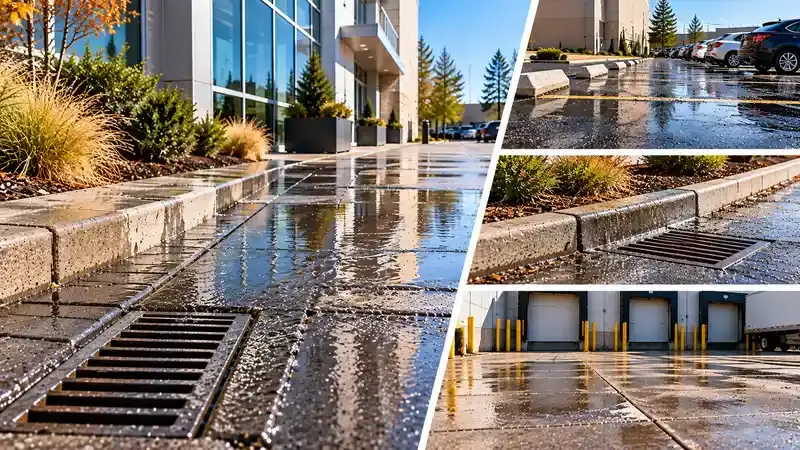
Drainage considerations for commercial power washing begin with understanding where water will move once it reaches an exterior surface. Commercial pavement, walkways, loading areas and building surroundings are rarely completely level. Slopes, curbs, drains, landscaped edges and low areas all influence where water travels and where material carried by that water can collect.
These conditions can vary considerably across one property. Water may move efficiently away from one entrance while collecting along a curb elsewhere. A paved area can direct runoff toward a drain, while another section may allow water to spread toward an adjoining surface or settle in a depression.
For property managers, observing these existing conditions provides useful context before exterior washing takes place. Where suitable surfaces require cleaning, commercial power washing for exterior property surfaces should be considered alongside the way water already moves through the site.
What Drainage Considerations for Commercial Power Washing Matter?
Drainage considerations for commercial power washing involve more than locating the nearest drain. The entire path that water can take across an exterior area matters. Surface slope influences the initial direction of movement. Curbs and pavement edges can redirect that flow. Low points can slow or collect water, while drains and catch basins provide locations toward which surrounding pavement may be designed to direct runoff.
The material already present on the surface also affects what happens as water moves.
Loose dirt, leaves, grit and other debris can be carried from one location to another. Adhered buildup may remain on the surface, while smaller loose particles can travel with runoff and become concentrated farther away. Adjacent areas deserve attention as well.
A walkway may border landscaping. A loading area may connect with a vehicle lane. Pavement near a building can meet entrances, walls or other exterior features. Looking at these conditions together gives a clearer picture of how washing water may interact with the property.
Surface Slope Influences Where Water Travels
Even when commercial pavement appears flat, it commonly contains some degree of slope.
That slope helps determine which direction water travels after reaching the surface. On a simple open paved area, the movement may be easy to observe. More complex sites can contain several changes in elevation that direct water through different routes.
Small variations can matter.
A section of walkway may direct water toward its edge, while an adjoining area sends it toward a curb. Parking pavement can contain broader grades that move water toward catch basins or lower portions of the site. Existing wear can also affect movement. Depressions and uneven areas can interrupt the intended path and create localized pooling. Repairs or transitions between materials may change how water crosses the surface.
Observing slope before washing helps property managers understand where water is naturally likely to travel rather than assuming it will simply remain within the immediate cleaning area.
Curbs and Edges Can Redirect Runoff
Curbs frequently act as boundaries for moving water. On parking lots and vehicle areas, runoff may follow a curb line toward a drainage point. Along walkways, raised edges can keep water within a particular path or redirect it toward an adjoining area. Exterior edges can also collect material.
Leaves, grit, soil and other debris may already be present where pavement meets a curb or landscaped border. Moving water can transport additional loose material toward the same location. This can create concentrations away from the surface originally being washed.
Edges around buildings deserve similar consideration. Water moving from an open paved area may encounter steps, walls, landscaping or another surface with a different elevation.
Understanding these boundaries helps explain where water and loose material are likely to move once exterior washing begins.
Drains and Catch Basins Should Be Visually Reviewed
Commercial properties can contain catch basins, trench drains, grates and other drainage features within or beside exterior areas. Their location provides useful information about the site's intended water movement. A drain positioned at a low point may receive runoff from a substantial portion of surrounding pavement.
A trench drain near an entrance or loading area can intercept water moving across a narrower route. Visible condition is relevant. Leaves, sediment or loose debris can accumulate around grates and openings. If significant material is already present, additional water movement can carry more debris toward the same location.
A visual review can also reveal whether the surrounding pavement appears to direct water toward the feature as expected or whether nearby low areas are holding water elsewhere.
This is not a substitute for assessing or repairing a drainage system. It is simply an important part of understanding the exterior conditions around a planned washing area.
Low Areas Can Hold Water After Surrounding Surfaces Drain
Some exterior areas retain water longer than their surroundings. Depressions, uneven pavement and changes in elevation can create localized low points where runoff settles. These areas may be visible after rainfall or snowmelt even before power washing is considered.
Existing pooling provides useful information.
If water routinely remains in a location after ordinary precipitation, washing water may behave similarly. Loose material carried into that area can also remain after the water eventually evaporates or drains away. Low points can occur on several types of commercial exterior surfaces.
Parking pavement, loading areas, walkways and paved spaces near entrances can all contain localized depressions. The condition may be minor or may indicate a larger surface or drainage concern. Recognizing the pattern beforehand helps distinguish an existing site characteristic from something caused by exterior washing.
Loose Material Can Move With Washing Water
Water can transport material that was previously sitting loosely on an exterior surface.
Sand, grit, soil, leaves and small debris can shift across pavement as water moves. If a substantial amount is present, allowing it all to travel with runoff can simply relocate the material elsewhere on the property.
That is why the distinction between sweeping and washing remains important. Where loose accumulation is significant, commercial sweeping for loose pavement material can address that material before adhered surface buildup is considered. After loose debris is reduced, water movement becomes easier to evaluate.
The remaining washing requirement can then focus more clearly on material attached to a suitable surface rather than using water to move large amounts of debris from one location to another. This is particularly relevant around curbs, drains and low areas, where transported material can become concentrated.
Adjacent Areas Can Affect Runoff Conditions
A commercial washing area does not exist independently from the rest of the property. Pavement can border planting beds, grass, building walls, neighbouring paved areas or service routes. Water moving from the intended cleaning area may encounter any of these features.
The transition between surfaces matters.
A raised landscape bed can form a boundary, while a lower landscaped area may receive water from adjacent pavement. A walkway can connect directly with a parking surface, allowing water to continue beyond the original work area. Different exterior materials can also affect movement. Water may travel quickly across smooth pavement and slow when it reaches a textured or uneven section.
Joints and edges can redirect small amounts of flow. Considering adjacent areas helps property managers understand the likely path beyond the exact surface being washed. It also provides context for any existing accumulation found along borders, since some of that material may already have been transported there by ordinary rainfall and property drainage.
Existing Water Patterns Can Reveal Property Conditions
Rainfall and snowmelt can provide useful evidence about how an exterior area drains.
Water marks, sediment lines and repeated accumulation around certain edges can indicate common runoff paths. Persistent dampness can identify locations that dry more slowly, while recurring puddles can reveal low points.
These observations are useful because they reflect the property's existing behaviour.
If a curb regularly collects sediment after rainfall, it may also receive loose material moved during exterior washing. If water repeatedly pools beside a pavement repair, the same location deserves attention when cleaning nearby surfaces.
The objective is not to diagnose an entire drainage system from surface observations.
Instead, existing water patterns help establish reasonable expectations about how the immediate exterior area behaves. Where observations suggest a condition beyond ordinary surface drainage, the underlying issue may need separate evaluation rather than being treated as a cleaning concern.
Drainage Considerations for Commercial Power Washing FAQs
Why should drainage be reviewed before commercial power washing?
Reviewing drainage helps identify surface slopes, runoff paths, low areas and drainage features that influence where washing water and loose material are likely to travel.
Can power washing water collect in low areas?
Yes. If an exterior surface already contains depressions or areas where rainwater tends to pool, washing water can follow the same existing pattern.
Should loose debris around drains be removed before power washing?
Substantial loose leaves, sand, grit or other debris should be evaluated separately. Removing loose material can reduce the amount transported toward drains, curbs and low areas during washing.
Does power washing fix poor drainage?
No. Power washing addresses appropriate removable exterior buildup. Persistent pooling, damaged drainage features or other underlying drainage problems may require a different property-maintenance response.
Understand Water Movement Before Exterior Washing
Commercial exterior surfaces already have established patterns of water movement before power washing begins. Slope directs runoff across pavement. Curbs and edges can redirect it. Drains receive water from surrounding areas, while depressions can hold moisture after other surfaces have dried. Loose material can also travel with that water and become concentrated elsewhere.
Observing these conditions helps property managers understand the work area more accurately. It can reveal where loose debris should be addressed first, where water commonly collects and how the intended washing area connects with surrounding exterior surfaces.
This does not turn power washing into a solution for drainage deficiencies. Instead, it keeps the cleaning work grounded in the actual conditions of the property.
Where exterior surfaces are suitable for washing and site water movement has been considered, professional exterior washing for commercial surfaces can be approached with a clearer understanding of how the area drains.