


Parking Lot Conditions That Affect Power Sweeping
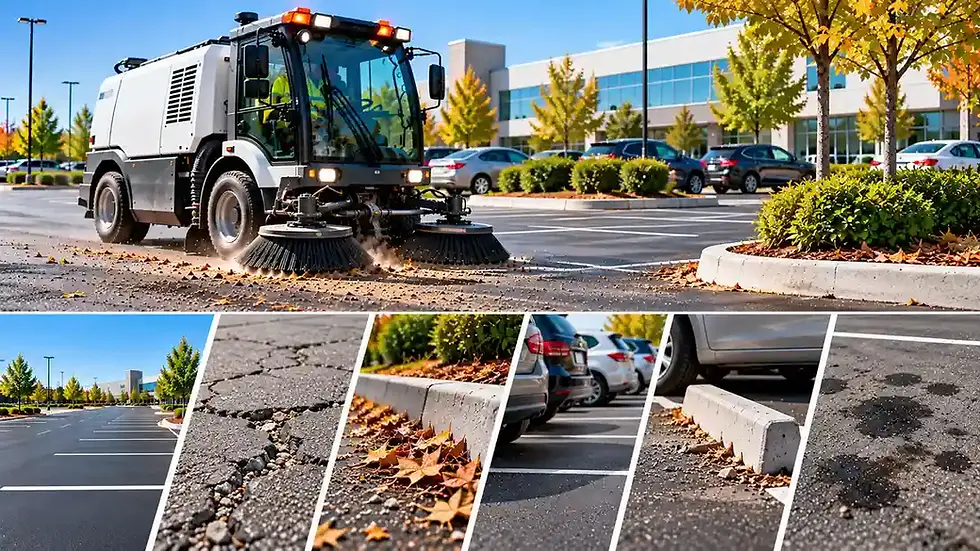
Commercial parking lots may appear straightforward from a distance, but the conditions affecting power sweeping can vary substantially across the same property. Open parking rows, landscaped islands, curbs, pavement deterioration, traffic patterns and areas occupied by vehicles can all influence where debris collects and how effectively sweeping equipment can move through the site.
The amount of pavement is only part of the picture. A large, open lot with predictable traffic can present different sweeping conditions from a smaller area divided by islands, irregular edges and heavily occupied parking spaces. The type and location of loose debris add another layer to that difference.
For Ontario property managers, evaluating these conditions provides a clearer understanding of what a parking lot requires. It also helps distinguish issues that affect the sweeping operation from stains, pavement damage and other conditions that mechanical sweeping is not intended to correct.
What Parking Lot Conditions Affect Power Sweeping?
The principal parking lot conditions that affect power sweeping include pavement layout, surface condition, curb configuration, debris distribution, vehicle activity and accessibility. These factors determine both where loose material tends to collect and how sweeping equipment can reach it.
Open pavement generally allows a more continuous equipment path. Parking islands, medians, irregular boundaries and other features divide that pavement into smaller working areas and create additional edges where material can gather.
Conditions can also vary during the day. A nearly empty lot may provide broad access, while the same property can become substantially more restricted once employees, customers or tenants occupy the parking spaces. Looking at the parking lot as a functioning environment rather than simply an area measurement provides a more useful basis for understanding its sweeping requirements.
Parking Lot Layout Influences Equipment Movement
The physical arrangement of a parking lot affects how a sweeper can travel through it.
Long parking rows and open drive aisles can provide relatively continuous routes. More complex layouts may contain landscaped islands, medians, pedestrian crossings, turning areas and separated parking sections that require more changes in direction.
Dead ends and irregular corners can create additional considerations because equipment cannot always approach them in the same way as open pavement. Connections between parking sections can also determine whether the sweeper can move efficiently from one area to another.
These characteristics do not determine whether the entire parking lot can be swept. They help explain why two lots of similar size can present very different operating conditions.
Pavement Condition Can Affect the Sweeping Environment
Parking-lot pavement changes over time. Asphalt can crack, ravel or develop broken edges, while concrete areas can develop deterioration around joints and transitions. Loose material resting on otherwise stable pavement should be distinguished from material associated with deterioration of the surface itself.
Small stones introduced from elsewhere are not necessarily the same condition as aggregate separating from aging asphalt.
Depressions and uneven areas can also influence where loose material settles. A localized low point may retain grit or organic debris differently from surrounding pavement.
Mechanical sweeping can collect appropriate loose material around many pavement features, but it does not repair the surface underneath. Where significant deterioration exists, the condition should be recognized independently rather than treated only as a debris problem.
Curbs and Islands Create Natural Debris Collection Areas
Parking lots contain many boundaries that interrupt open pavement. Curbs, landscaped islands, medians and perimeter edges are common examples. Wind and vehicle movement can push lightweight material toward these boundaries.
Sand, grit and other particles can also migrate away from open traffic surfaces and become more noticeable along edges. Landscaped islands can introduce additional organic material. Leaves, small twigs, soil and plant debris may move directly from landscaped sections onto nearby parking spaces and drive aisles.
As a result, a parking lot can appear relatively clear through its centre while carrying concentrated material around its perimeter features. commercial power sweeping for paved parking areas should therefore account for the way the entire parking environment is configured rather than focusing only on open pavement.
Traffic Patterns Can Redistribute Loose Material
Vehicle movement continually changes the location of debris within a parking lot.
Material entering through driveways can be carried farther into the property by tires. Turning movements can redistribute grit around intersections and parking rows, while repeated traffic can move lightweight debris away from one location and toward another.
Entrances and exits can therefore show different conditions from remote parking spaces. Areas close to public roads may receive material introduced from outside the property, while internal routes may reflect the movement patterns of vehicles already on site.
Traffic can also make debris patterns less stable. A concentration visible early in the day may become dispersed after periods of heavier vehicle movement. Understanding these patterns helps explain why debris distribution is not necessarily consistent across the entire parking lot.
Parked Vehicles Reduce Accessible Pavement
Occupied parking spaces create one of the most visible access limitations in a commercial parking lot. A sweeper cannot service pavement directly underneath a parked vehicle, and closely spaced vehicles can restrict access to nearby areas.
A parking lot that remains heavily occupied throughout its operating hours can therefore present different coverage conditions from one with predictable low-occupancy periods.
This does not mean a parking lot must be completely empty before any sweeping can occur. It does mean that the amount and location of occupied pavement influence what can reasonably be reached during a particular visit.
The issue becomes especially important when the same spaces remain occupied repeatedly. Material can persist in those locations even when surrounding pavement is regularly accessible.
For property managers, occupancy should therefore be understood as a physical access condition rather than simply a scheduling inconvenience.
Wheel Stops and Fixed Features Can Create Obstructed Areas
Wheel stops, bollards, light standards, utility structures and other fixed features can interrupt otherwise accessible pavement. Loose debris can accumulate around these objects because vehicle movement and wind push material toward areas that receive less direct traffic.
Their shape and position can also create confined spaces that equipment cannot approach in the same manner as an open drive aisle. Parking-lot design can multiply these small areas across a property. A single obstruction may have little effect, while numerous repeated features can materially change the character of the paved environment.
This is another reason that total area alone cannot describe parking-lot sweeping conditions. The number and arrangement of physical features influence how much of that area is straightforward to access.
Stains and Pavement Damage Should Be Separated From Sweepable Debris
Once loose material has been collected, other parking-lot conditions may become more visible.
Oil-related marks, tire staining, adhered grime and embedded discoloration cannot be removed simply by continuing to sweep the same pavement.
Where suitable surfaces contain adhered exterior buildup, commercial power washing for appropriate pavement buildup addresses a different type of maintenance condition.
Cracks, potholes, broken pavement and failed surfaces are different again. Cleaning can expose these conditions, but it cannot repair them.
Separating these issues is important when reviewing sweeping results. A parking lot can be successfully cleared of loose debris while still displaying stains or physical deterioration. Those remaining conditions do not necessarily indicate that additional sweeping is required.
Parking Lot Conditions That Affect Power Sweeping FAQs
Does a parking lot need to be empty for power sweeping?
Not necessarily. However, parked vehicles prevent access to the pavement beneath and immediately around them. Lower occupancy can increase the amount of pavement available during a sweeping visit.
Do parking islands make a lot harder to sweep?
Islands change the pavement layout and create additional curbs and edges where debris can collect. Their effect depends on their number, arrangement and the amount of accessible pavement around them.
Can power sweeping remove debris from cracked pavement?
Appropriate loose debris may be collectable from pavement containing some cracks, but the condition and severity of the surface matter. Sweeping does not repair the cracking or other deterioration.
Why does debris collect around parking lot curbs?
Wind, vehicle movement and surface conditions can move loose material away from open pavement toward boundaries such as curbs, islands and perimeter edges, where it can become concentrated.
Evaluate the Whole Parking Lot Before Sweeping
Parking-lot sweeping requirements are shaped by more than the total amount of pavement. Layout, surface condition, curbs, islands, traffic, occupancy and fixed features all affect where debris accumulates and what pavement can be reached.
Reviewing these characteristics also makes it easier to distinguish sweepable material from other exterior conditions. Staining and pavement deterioration can remain after loose debris has been removed because they require a different type of response.
For Ontario commercial properties, the most useful approach is to evaluate the parking lot as an active paved environment. professional commercial power sweeping for Ontario parking areas can then be matched to the accessible pavement and loose-debris conditions actually present on the property.